

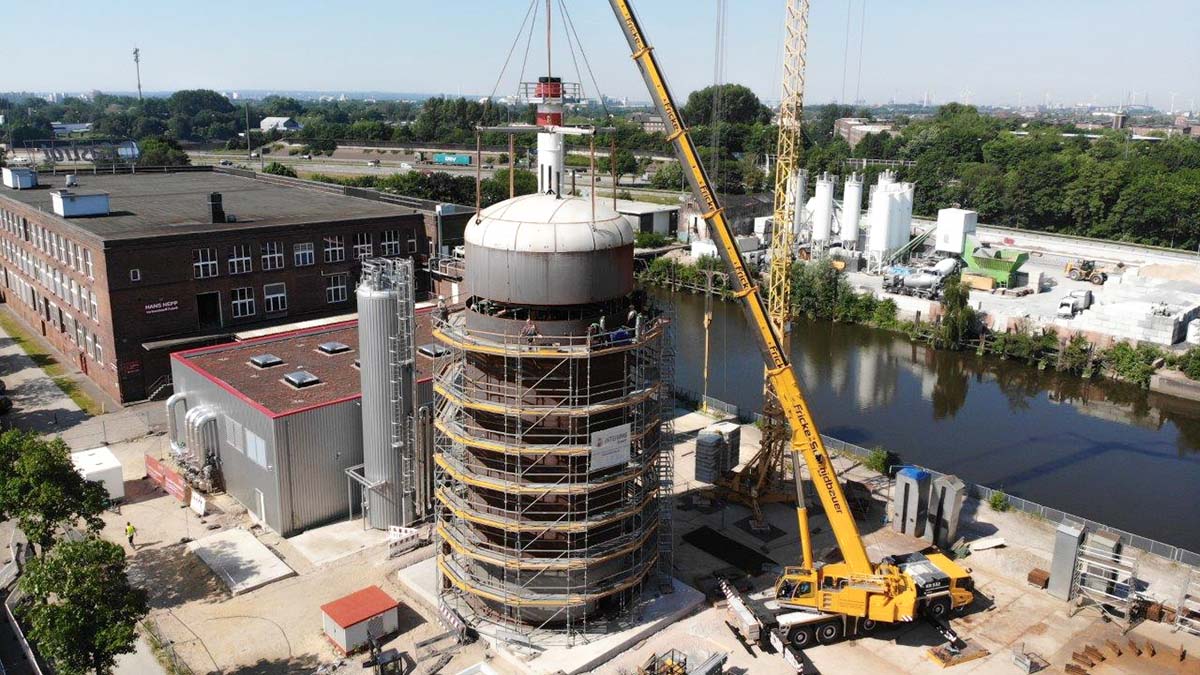

Pressure heat storage system supplies local heating network in HafenCity
In 2020 and 2021, enercity Contracting Nord GmbH (eCNG), a subsidiary of Germany’s fifth-largest municipal energy service provider, enercity AG, built a new energy center on Georgswerder Damm in Hamburg to utilize CO2-free industrial waste heat from the Aurubis AG copper smelter for heat supply. enercity now supplies its customers in the newly emerging HafenCity district as well as in Rothenburgsort and Veddel via a local heating network.
One challenge was the need to bring the highly fluctuating waste heat to a uniform temperature and store it temporarily in order to make it usable. For this reason, eCNG requested two alternative storage types, pressureless and pressurized, in the tender. Max Straube, as a sister company of Kremsmüller, made a corresponding offer. After intensive discussions between Kremsmüller, Max Straube, and the customer enercity, a joint decision was made in favor of the pressurized heat storage solution.
Decision in favor of pressure heat storage tanks
The reasoning behind this is that with a pressureless heat storage tank, it would be more difficult and, in the long term, more expensive to ensure constant pressure equalization between the heat storage tank and the pressurized pipe network during operation. Electric pumps would also be required to charge and discharge the heat storage tank, which would incur ongoing costs. In addition, the pressureless version would require a gas buffer above the storage medium water, for example nitrogen, because normal air in contact with water impairs the quality of the storage medium and leads to increased corrosion.
Another challenge in implementing the project in 2020, as everywhere else, was the restrictions and regulations imposed at the start of the COVID-19 pandemic. Kremsmüller was able to ensure that the work was carried out without any problems by implementing a suitable hygiene concept.
Future-oriented planning
In addition to natural gas, the boiler system can also be operated with up to 20% hydrogen. Max Straube took this technology into account during the planning stage, for example by selecting suitable burner technology. The system is also well prepared for expansion: during peak load times, the boilers can deliver over 40 MW of thermal output. This means that even more buildings in Hamburg will benefit from CO₂-free waste heat in the future.


Download Whitepaper
In our heat storage technology dossier, you will find all case studies and technical information collected for download.